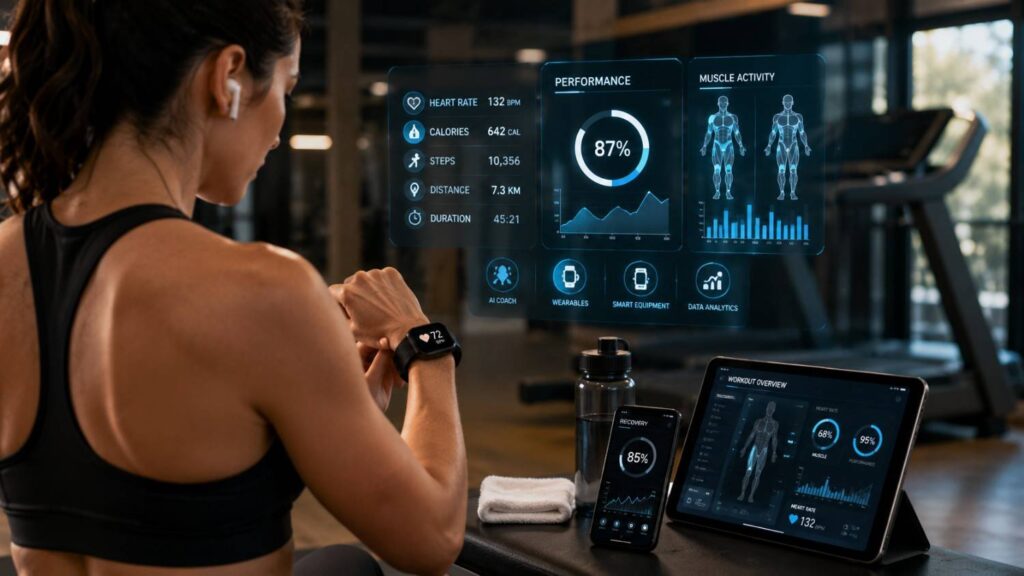
The Latest Trends in Fitness Technology: What Is Shaping Fitness in 2026?
The Latest Trends in Fitness Technology reflect a broader change in how people approach exercise, recovery, and personal health. Fitness technology is no longer limited to gym equipment or simple pedometers. It now includes wearable sensors, artificial intelligence, virtual coaching, connected exercise machines, mixed reality environments, health-data platforms, and applications that adapt to individual behaviour.
This development has created a more personalized fitness experience. Instead of following the same generic plan as every other user, individuals can receive recommendations based on their workout history, activity patterns, available time, sleep, heart-rate trends, and selected goals. Athletes can review training load and recovery indicators, while beginners can receive reminders, guided sessions, and simplified progress summaries.
The American College of Sports Medicine has continued to identify wearable technology, mobile exercise applications, and data-driven training as important industry trends. These categories are closely connected. Wearables collect information, applications organize it, and data-driven platforms attempt to turn it into recommendations.
However, more technology does not automatically produce better fitness outcomes. A device cannot guarantee consistency, improve technique without user engagement, or replace qualified medical advice. Some metrics are estimates, and many readiness or recovery scores are created through proprietary algorithms that users cannot fully examine.
The most meaningful innovation occurs when technology reduces uncertainty and supports better decisions. A useful system may help a runner manage pace, allow a strength trainee to record progressive overload, remind an office worker to move, or help a coach identify patterns across several weeks of training.
For beginners, the growing number of options can feel overwhelming. Advanced users may face a different problem: too much information from multiple devices and platforms. This guide explains the major developments, their practical benefits, their limitations, and the questions users should ask before adopting them.
Why Is Fitness Technology Moving From Tracking to Guidance?
Fitness technology is moving toward guidance because simple measurement is no longer enough for most users. Recording steps, workout duration, or heart rate can describe activity, but these figures do not always explain whether the user is progressing, recovering effectively, or training at an appropriate level. As people collect more information, the need for interpretation becomes increasingly important.
Modern platforms attempt to solve this problem by combining several types of data. A fitness application may review recent exercise sessions, sleep patterns, resting heart rate, completed training volume, and stated goals before recommending the next workout. Instead of presenting isolated numbers, it may summarize whether the user is maintaining consistency, increasing workload too quickly, or failing to allow enough recovery.
This shift also reflects changes in consumer expectations. Users increasingly want technology that feels personalized and responsive. They do not want to manually study several charts before making a basic decision. They expect applications to explain patterns in natural language and provide practical next steps.
For coaches and fitness professionals, guidance-based systems can reduce administrative work. Automated tracking can organize exercise history, identify missed sessions, and highlight unusual changes. This allows the professional to spend more time on technique, motivation, communication, and programme design.
Nevertheless, guidance should remain understandable and adjustable. A recommendation is only useful when users know which information influenced it. Systems should allow people to correct inaccurate records, report how they feel, and override suggestions when circumstances change.
The transition from tracking to guidance is therefore not about removing human judgment. It is about making fitness data easier to use while preserving the context that technology may not fully understand.
For a broader perspective on fitness industry trends, industry experts have also highlighted the growing shift toward personalized coaching, wearable innovation, and data-driven training strategies.
Wearables Remain the Foundation
Wearable fitness technology remains the foundation of data-driven exercise because wearable devices collect information continuously and with relatively little effort from the user. Smartwatches, rings, bands, heart-rate straps, GPS devices, sensor patches, and emerging smart glasses can record activity during workouts as well as patterns across the rest of the day.
The main advantage of continuous monitoring is context over time. A single fitness assessment may show how someone performs on one particular day. A wearable can reveal whether activity levels are consistent across several weeks, whether resting heart rate is changing, or whether sleep patterns appear different during demanding training periods.
Wearables can also make workout recording more convenient. A runner can track route, pace, distance, and heart rate without manually entering each detail. A strength trainee may use a connected device to record sets or repetitions. A general user can monitor daily activity and receive reminders when long periods of inactivity occur.
However, wearable measurements should be interpreted according to their intended purpose. Step counts, calorie estimates, heart-rate readings, and sleep stages may vary between devices. Fit, placement, skin contact, movement type, and algorithm design can influence the result.
The most useful approach is to focus on consistent trends rather than treating every reading as exact. When the same device is worn regularly under similar conditions, changes over time may provide more practical value than comparisons with another person’s numbers.
Artificial Intelligence Turns Data Into Actions
Artificial intelligence is becoming the interpretation layer within many fitness platforms. It can review large amounts of workout and health-related information more quickly than a user could manually examine. The system may then summarize patterns, suggest adjustments, answer questions, or provide personalized encouragement.
Apple’s Workout Buddy, for example, uses workout information and fitness history to deliver personalized spoken messages during selected activities. Google has also introduced a Fitbit personal health coach designed to combine fitness, sleep, and wellness information through Gemini-powered interactions. These examples illustrate how technology companies are moving from static dashboards toward conversational guidance.
AI fitness coaching may help users understand complex measurements. Instead of showing only a chart, a platform could explain that training volume increased sharply, sleep duration declined, or workout consistency improved. It may also suggest a shorter session when recent activity has been unusually demanding.
The quality of the recommendation depends on the quality and completeness of the available information. AI may not know that the user is injured, travelling, fasting, taking medication, experiencing unusual stress, or using a poorly fitted sensor. It can also misinterpret missing or incorrect records.
For that reason, AI-generated advice should be treated as informed assistance rather than unquestionable instruction. The best systems explain the reasoning behind a recommendation, allow users to provide feedback, and make it easy to adjust goals or preferences when circumstances change.
How Are Wearables Becoming Smaller and Less Distracting?
Wearable technology is becoming smaller, lighter, and less dependent on screens. This change reflects a growing demand for continuous monitoring without constant digital interruption. Many users want the benefits of activity, recovery, and sleep tracking but do not want another device sending frequent notifications or competing for attention throughout the day.
Smart rings, screenless bands, sensor patches, and audio-based interfaces are designed to collect or deliver information more quietly. Instead of displaying every measurement immediately, these devices may store data and present a summary later through a connected application. This approach is particularly useful for sleep and recovery monitoring, where comfort and consistent wear can matter more than a large display.
The development of smaller wearables also expands the range of situations in which tracking is practical. A ring may be less intrusive during sleep. A lightweight sensor may fit beneath clothing. Smart glasses or audio prompts can provide hands-free information during running, cycling, or outdoor training.
However, smaller size creates trade-offs. Devices with limited displays may provide fewer live workout controls, shorter interaction options, or reduced battery capacity. Some products require a smartphone for almost every detailed review. Users must decide whether they value passive monitoring or immediate feedback.
Another important consideration is behavioural impact. A device that constantly displays scores can encourage useful accountability, but it may also create anxiety or compulsive checking. Low-distraction designs can help users focus on the activity itself rather than monitoring every number.
The growing popularity of smaller wearables therefore represents more than a design trend. It reflects a shift toward ambient technology that supports health and fitness in the background.
Smart Rings and Screenless Trackers Support Passive Monitoring
Smart rings and screenless fitness trackers are designed primarily for passive monitoring. They can collect information such as movement, resting heart rate, sleep duration, temperature trends, and recovery-related signals without requiring frequent interaction. For many users, this creates a more comfortable and less distracting experience than a traditional smartwatch.
One of the strongest use cases is overnight wear. Some people find large watches uncomfortable during sleep, especially when the device has a bright screen or requires a tight strap. A compact ring or lightweight band may be easier to wear consistently, which can improve the continuity of collected information.
Screenless devices may also encourage users to review trends at appropriate times instead of reacting to every measurement. Rather than checking a readiness score immediately after waking, the user can open the application later and consider the information alongside mood, soreness, energy, and planned activity.
These products are not ideal for every purpose. Runners who need real-time pacing, cyclists who want navigation, or athletes who rely on live heart-rate zones may prefer a watch or dedicated sports computer. Rings can also be uncomfortable during heavy barbell training or exercises involving strong gripping.
Users should therefore choose based on the activity rather than the popularity of the device. Smart rings and screenless trackers are generally strongest when passive monitoring, sleep comfort, and reduced distraction are more important than detailed live feedback.
Smart Glasses and Audio Interfaces Enable Hands-Free Feedback
Smart glasses and audio-based fitness interfaces are introducing a hands-free method of receiving workout information. Instead of looking down at a watch or stopping to check a smartphone, users may hear pace updates, navigation prompts, heart-rate information, or coaching messages while continuing to move.
This format can be valuable during activities where visual attention should remain focused on the environment. Runners may benefit from spoken split times, while cyclists may prefer audio alerts rather than repeatedly checking a wrist display. Outdoor athletes may also receive route guidance or performance summaries without interrupting their movement.
Meta has demonstrated performance-oriented AI glasses that connect with fitness platforms such as Garmin and Strava. These developments suggest that voice interaction and wearable displays may become more closely integrated with training data.
The convenience of hands-free feedback must be balanced against safety. Too many prompts can become distracting, particularly during road cycling, trail running, or exercise in crowded environments. Audio volume should not prevent users from hearing vehicles, other people, or warning signals.
Comfort, battery life, prescription-lens compatibility, weather resistance, and data privacy are additional considerations. Users should also ask whether the information truly needs to be delivered in real time.
Hands-free interfaces are most useful when they reduce unnecessary movement or screen checking. They become less valuable when they add constant commentary that interrupts concentration or awareness.
How Is AI Changing Personalized Fitness Coaching?
AI is changing personalized fitness coaching by making exercise programmes more responsive to the user’s behaviour and circumstances. Traditional digital plans often follow a fixed schedule. They may prescribe the same workout regardless of whether the previous session was completed, the user slept poorly, or available training time changed unexpectedly.
AI-powered platforms can adjust recommendations by reviewing recent activity, workout history, preferred exercise types, equipment access, and selected goals. Some systems also incorporate wearable information such as heart rate, sleep duration, or training load. This allows them to recommend changes that feel more relevant than a static programme.
Personalization can improve accessibility for beginners. A new user may not know how to select exercises, balance training days, or progress gradually. An AI coach can provide structure, demonstrations, reminders, and explanations. Advanced users may benefit from automated summaries, workload tracking, and suggestions based on longer-term performance patterns.
However, personalization is only as effective as the information supplied. Incorrect goals, incomplete workout records, or inaccurate sensor readings can lead to weak recommendations. AI may also struggle to evaluate pain, exercise technique, motivation, mental health, or complicated medical circumstances.
The role of AI should therefore be supportive. It can organize information, identify patterns, and make routine adjustments, but users still need judgment. Qualified coaches remain important when exercise involves injury rehabilitation, complex technique, performance competition, chronic health conditions, or significant lifestyle barriers.
The most promising development is not fully automated coaching. It is the combination of efficient machine analysis with human communication, accountability, and professional decision-making.
Adaptive Workouts Respond to Real-Life Changes
Adaptive workouts are designed to change when the user’s circumstances change. A fixed programme assumes that every planned session will occur under similar conditions. Real life rarely works that way. Sleep may be poor, work schedules may become demanding, equipment may be unavailable, or previous training may create more fatigue than expected.
An adaptive platform can respond by shortening the workout, reducing intensity, changing the exercise selection, or moving a demanding session to another day. For example, a user who misses two workouts may receive a modified weekly schedule rather than being told to complete several sessions consecutively. A runner whose recent training load increased sharply may be advised to complete an easier session.
Connected strength equipment and movement-analysis tools can also adjust resistance, count repetitions, or identify changes in range of motion. These features may help users maintain consistency and record progression more accurately.
The system should explain why a modification was made. An unexplained change can reduce trust, especially when it conflicts with how the user feels. Clear reasoning allows the user to decide whether the suggestion is appropriate.
Adaptive workouts should also avoid reacting too strongly to one unusual measurement. A single poor night of sleep or incomplete heart-rate reading should not automatically disrupt an entire programme.
The best adaptive systems combine recent data, longer-term trends, and user feedback before recommending meaningful changes.
Human Coaches Are Becoming Interpreters of Technology
As fitness technology becomes more advanced, human coaches are increasingly responsible for interpreting its information rather than simply collecting it. Wearables and applications can automate workout logs, heart-rate records, exercise duration, and recovery measurements. A qualified professional can then place that data within a broader personal context.
A platform may show that a client’s resting heart rate increased for several days. The technology can identify the pattern, but the coach can ask whether the client is ill, under unusual stress, sleeping poorly, travelling, or using a new medication. The same number can have several possible explanations.
Coaches also understand factors that are difficult to measure. They can observe exercise technique, confidence, communication style, fear of injury, motivation, and willingness to follow a programme. These human factors often determine whether a technically correct plan is realistic.
Technology can make coaching more efficient. Automated reports may reveal missed sessions, inconsistent training times, or changes in workload before the next appointment. This allows the coach to prepare more useful questions and make evidence-informed adjustments.
However, professionals also need data literacy. They should understand the limitations of wearable measurements and avoid presenting every score as exact.
The strongest coaching model is collaborative. Technology collects and organizes information, the coach interprets it, and the client contributes personal experience. This combination produces recommendations that are more practical, transparent, and responsive.
Why Are Recovery, Sleep, and Readiness Scores So Popular?
Recovery, sleep, and readiness scores have become popular because users increasingly understand that progress does not depend only on completing harder workouts. Adaptation occurs when training stress is balanced with sufficient rest, nutrition, sleep, and time between demanding sessions. Fitness technology attempts to make this balance easier to observe.
Wearables may estimate readiness by combining resting heart rate, heart-rate variability, recent activity, sleep duration, respiratory rate, and other measurements. The final result is often presented as a simple score or category, such as low, moderate, or high readiness.
This simplified presentation is appealing because it turns several complex metrics into one apparent decision. A user can quickly see whether the platform recommends intense training, moderate activity, or additional recovery. Coaches can also use these trends to begin conversations about workload and lifestyle habits.
The limitation is that readiness is not directly measured in the same way as body weight or elapsed time. It is estimated through an algorithm. Different companies use different formulas, which means two devices may produce different scores from similar data.
Sleep estimates also have limitations. Consumer wearables can be useful for identifying routines and trends, but they are not identical to clinical sleep assessments. Users should avoid interpreting every estimated sleep stage as exact.
Recovery technology is most valuable when it encourages reflection rather than obedience. A score should prompt the user to consider how they feel, how recent sessions performed, and whether unusual symptoms are present.
When used appropriately, these tools can support better pacing. When treated as absolute commands, they may create unnecessary anxiety or reduce confidence in personal judgment.
HRV and Sleep Data Can Reveal Personal Patterns
Heart-rate variability, commonly called HRV, describes variation in the time between heartbeats. It is influenced by the autonomic nervous system and is often used as one indicator of stress, recovery, or readiness. Many wearable platforms measure HRV during sleep or periods of rest because movement can affect the reading.
The most useful way to interpret HRV is through an individual baseline. People naturally have different values, so comparing one user’s number with another person’s score may provide little practical insight. A consistent change from the user’s own normal pattern is often more informative.
Sleep data can add important context. If HRV decreases while sleep duration, resting heart rate, mood, and workout performance also worsen, the overall pattern may suggest increased stress or incomplete recovery. A single lower reading without other changes may simply reflect normal variation or measurement error.
Research reviews suggest that HRV can contribute to training and recovery assessment, but it should not be used alone. Hydration, illness, alcohol, travel, psychological stress, and changes in routine can all influence the measurement.
Users should also consider how the device collects the data. Consistent wear, proper fit, and similar measurement conditions improve comparability over time.
HRV and sleep information are therefore most valuable as trend indicators. They can help users ask better questions about recovery, but they should not be treated as medical diagnoses or automatic instructions.
More Data Does Not Automatically Mean Better Decisions
The fitness industry often presents additional measurements as an automatic improvement. In reality, more data can create confusion when users do not understand what each metric represents or how it should influence behaviour. Multiple devices may also produce conflicting scores, leaving the user uncertain about which recommendation to follow.
A readiness score may combine several useful signals, but it remains an estimate. The algorithm may not account for every relevant factor, and the company may not disclose exactly how each input is weighted. A low score could reflect genuine fatigue, a poorly fitted device, an unusual sleep schedule, or incomplete data.
Users should avoid changing an entire training programme because of one isolated result. Longer-term patterns are generally more informative. It is useful to compare the score with subjective information such as soreness, energy, mood, motivation, pain, and perceived effort during recent workouts.
This does not mean recovery data should be ignored. It means the information should support a broader decision rather than control it.
A practical approach is to look for agreement between several indicators. If the device shows reduced readiness and the user also feels unusually tired, performs poorly, and has slept badly for several nights, adjusting training may be sensible.
Technology should strengthen body awareness. It should not make users afraid to exercise because a number changed or encourage them to ignore pain because a dashboard appears positive.
Are Metabolic Sensors Becoming Part of Everyday Fitness?
Metabolic and physiological sensors are becoming more visible within consumer fitness because users want information that goes beyond steps, distance, and heart rate. Continuous glucose monitors, temperature sensors, electrocardiogram functions, oxygen measurements, and other biosensor-based tools are increasingly discussed in wellness, exercise, and recovery settings.
These devices can provide a more detailed view of how the body responds throughout the day. A user may observe patterns connected with meals, activity, sleep, stress, or training intensity. Athletes and coaches may also use selected measurements to explore recovery, energy management, or environmental adaptation.
However, the presence of a sensor does not automatically make a product appropriate for every user. Some measurements have established medical applications, while others are presented mainly as general wellness information. The intended use, regulatory status, accuracy, and interpretation requirements can vary significantly.
Consumer interest can also lead to overinterpretation. A person may make major dietary or training changes after seeing a temporary change without understanding normal biological variation. Data can appear precise while still requiring professional context.
Manufacturers, publishers, and fitness professionals should communicate these distinctions clearly. They should not describe a wellness feature as a diagnostic tool or imply that a device can identify a condition unless the product has been authorized for that purpose.
Metabolic sensors may become an important part of personalized fitness, but their value depends on responsible use. Users should understand what the device measures, what it does not measure, and which decisions should involve a qualified healthcare professional.
Continuous Glucose Monitoring Has Expanded Beyond Insulin Users
Continuous glucose monitors measure glucose levels in the interstitial fluid through a small sensor worn on the body. Traditionally, these systems have been strongly associated with diabetes management. More recently, access has expanded to selected over-the-counter products designed for adults who do not use insulin.
In March 2024, the U.S. Food and Drug Administration cleared the first over-the-counter continuous glucose monitor. The stated audience included adults interested in understanding how diet and exercise may influence glucose levels. This development increased public interest in metabolic information within fitness and wellness.
A user may observe how glucose changes following meals, physical activity, poor sleep, or stress. This can encourage curiosity about everyday habits and may help some people discuss patterns more effectively with a healthcare professional.
However, glucose responses are complex. They can be affected by meal composition, timing, recent exercise, hormones, illness, stress, and individual physiology. A temporary increase is not automatically harmful, and a flatter response is not always evidence that a food is healthier.
Users should avoid making medication changes or diagnosing a condition based on consumer fitness content. They should also follow the product’s official instructions and intended use.
Continuous glucose monitoring can provide meaningful information when used for a clear purpose. Without context, it may lead to unnecessary food restriction, anxiety, or oversimplified conclusions about nutrition and exercise.
Wellness Features and Medical Devices Are Not the Same
A wellness feature and a medical device may collect similar types of information, but their intended purposes can be very different. A general wellness product may encourage activity, support healthy habits, or provide non-diagnostic information. A medical device may be intended to diagnose, monitor, prevent, or treat a specific condition.
This distinction matters because regulatory expectations, evidence requirements, warnings, and user instructions may differ. The FDA provides guidance distinguishing certain low-risk general wellness products from functions that fall within medical-device regulation.
Users should review the manufacturer’s stated intended use rather than assuming that a health-related measurement has diagnostic value. A smartwatch feature that displays a trend may not be equivalent to a clinical test, even when both appear to measure a similar signal.
Before relying on a feature, users should check whether it has regulatory authorization for the claimed purpose, which populations were evaluated, and what limitations are listed. They should also understand what the product recommends when a reading appears unusual.
Fitness professionals and content publishers should use careful language. Phrases such as “may help users notice patterns” are more appropriate than claims that a consumer device can diagnose a disease without supporting evidence.
Wellness technology can still be valuable. It may encourage activity, improve awareness, and help users prepare questions for a healthcare appointment. Its usefulness does not require overstating what it can medically determine.
How Are Connected Ecosystems and Mixed Reality Changing Workouts?
Connected ecosystems are changing workouts by allowing information to move between devices, applications, coaching services, and exercise equipment. Instead of operating as isolated products, fitness tools increasingly function as parts of a wider digital environment.
A smartwatch may record a workout, a health-data platform may store the information, and a coaching application may use it to update a training plan. A connected scale, sleep tracker, or gym machine may contribute additional measurements. This reduces duplicate entry and gives users a more complete view of their activity.
Interoperability is especially important for users who rely on several services. Without data integration, the same workout may need to be recorded repeatedly. Information may also remain trapped inside one company’s platform, making it difficult to switch products or share records with a professional.
At the same time, virtual and mixed reality are changing how exercise is experienced. Fitness can now take place inside interactive environments that combine movement, games, instruction, and social participation. A home user may complete a boxing session, dance workout, or guided mobility class without traditional gym equipment.
These technologies can make exercise more engaging, but they also introduce practical concerns. Users need appropriate physical space, comfortable equipment, and awareness of nearby objects. Motion sensitivity, visual accessibility, and headset weight can affect participation.
Connected fitness should make exercise simpler rather than more fragmented. Users benefit most when data flows securely, permissions are understandable, and each product serves a clear purpose within the overall system.
The combination of interoperability and immersive exercise may create more flexible fitness experiences, but convenience should always be balanced with privacy, safety, and long-term usability.
Health Data Is Becoming More Interoperable
Health-data interoperability allows approved information to move between compatible applications and devices. Apple describes HealthKit as a central framework through which authorized applications can access and share health and fitness information. Android’s Health Connect similarly provides a structured way for compatible applications to store and exchange selected data.
This approach can reduce duplicate recording. A workout completed through one application may appear in another service used for coaching or recovery analysis. Step counts, exercise sessions, sleep information, and other supported measurements can contribute to a more complete personal record.
Interoperability can also reduce dependence on one brand. When users can export or share data, they have more freedom to change devices without losing their entire history. Coaches may benefit when clients can provide organized information from several sources.
The main concern is permission management. Each connection creates another path through which sensitive information may be accessed. Users should review which applications can read data, which can write new records, and whether the access is still necessary.
Old applications and unused services should be disconnected. Permissions should be limited to the information required for the feature to function. An application that tracks workouts may not need access to every available health category.
Interoperability is most valuable when users remain in control. A connected ecosystem should provide convenience without making personal information difficult to understand, restrict, export, or delete.
Mixed Reality Makes Home Fitness More Interactive
Mixed reality combines digital content with physical movement, creating workout experiences that can feel more interactive than watching a standard exercise video. Users may box against virtual targets, follow a trainer inside an immersive environment, complete dance routines, or participate in movement-based games.
This format can make home fitness more engaging for people who become bored with traditional cardio equipment. Immediate visual and audio feedback can create a sense of progress, while points, challenges, and levels may encourage repeated participation.
Meta Quest supports fitness-related tracking and integrations with platforms such as Apple Health and Android Health Connect. These connections allow selected activity information to become part of a broader digital fitness record.
Mixed reality is not automatically effective simply because the experience is entertaining. A meaningful workout still requires suitable intensity, duration, progression, and consistency. Users should choose applications that match their ability and provide appropriate movement guidance.
Physical safety is essential. The exercise area should be cleared of furniture, pets, cables, and other hazards. Users should follow boundary systems and stop if they experience dizziness, nausea, disorientation, or pain.
Headset weight, heat, sweat management, visual accessibility, and motion sensitivity may limit comfort. Some users may also prefer the social environment and equipment available in a physical gym.
Mixed reality works best as an additional exercise option rather than a universal replacement for every form of training.
Related Articles
How Should You Choose Fitness Technology That Actually Helps?
Choosing effective fitness technology requires more than comparing feature lists. The right product depends on the user’s goals, preferred activities, budget, existing devices, comfort, and willingness to review data. A highly advanced product can become an expensive distraction when it does not solve a meaningful problem.
The first step is to define the desired outcome. Someone training for a race may need accurate location tracking, pace information, structured workouts, and long battery life. A person trying to become more active may benefit from simple reminders, step tracking, and weekly progress summaries. A user focused on sleep may prioritize comfort and passive monitoring.
The next consideration is whether the information leads to action. A device may collect dozens of metrics, but only a few may influence the user’s decisions. Before purchasing, users should ask how each feature will change their training, recovery, or daily habits.
Compatibility is equally important. The product should work with the user’s phone, operating system, preferred applications, and existing equipment. Subscription fees, replacement sensors, accessories, and paid analytics should be included in the total cost.
Accuracy and intended use should also be reviewed. Consumer devices can provide useful trends, but not every feature is designed for medical decision-making. Official documentation should explain the purpose and limitations of each measurement.
Finally, users should consider privacy, comfort, battery life, and long-term adherence. A product that is uncomfortable, difficult to charge, or confusing to operate is unlikely to be used consistently.
The best fitness technology is not the most impressive product. It is the tool that removes friction, improves understanding, and supports sustainable behaviour.
| User Goal | Recommended Fitness Technology | Primary Feature | Best For |
|---|---|---|---|
| Improve Daily Activity | Smartwatch | Activity & heart-rate tracking | Beginners |
| Better Sleep Recovery | Smart Ring | Sleep and recovery insights | Everyday users |
| Personalized Workout Plans | AI Fitness Coach | Adaptive training recommendations | Regular exercisers |
| Endurance Training | GPS Sports Watch | Pace, distance, and route tracking | Runners & cyclists |
| Strength Progress | Connected Gym Equipment | Workout performance tracking | Strength athletes |
| Home Fitness | Mixed Reality Fitness | Interactive virtual workouts | Home users |
Follow This Step-by-Step Selection Process
Begin by writing down one primary objective. Avoid starting with a list of popular devices. A clear goal makes it easier to identify which features are essential and which are unnecessary.
Next, identify the minimum information required. A beginner may only need workout duration, step count, and basic heart-rate trends. An experienced endurance athlete may require GPS accuracy, route navigation, training load, pace zones, and external sensor compatibility.
The third step is to review compatibility. Confirm that the device works with your smartphone, operating system, preferred fitness applications, and existing health-data platform. Check whether important functions require a subscription.
The fourth step is to examine evidence and intended use. Read official product documentation and determine whether health-related features are intended for general wellness or have received relevant regulatory authorization.
Next, calculate the total cost. Include the purchase price, subscription fees, replacement straps, external sensors, charging accessories, and disposable components.
Privacy should be evaluated before creating an account. Review what information is collected, whether location tracking is required, and how data can be exported or deleted.
Finally, test the behavioural value. After several weeks, ask whether the technology improved consistency, decision-making, motivation, or understanding. If the device mainly creates anxiety or requires constant attention without changing behaviour, it may not be the right solution.
A structured selection process prevents users from paying for features they will never use.
Compare the Main Technology Categories
Each fitness technology category serves a different purpose. Smartwatches and sports watches are generally strongest for users who need live workout feedback. They can display pace, distance, heart rate, navigation, structured sessions, and notifications. Their disadvantages may include frequent charging, screen distraction, and a larger design.
Smart rings and screenless trackers focus more on passive monitoring. They are often suited to users who care about sleep, recovery, resting trends, and daily activity but do not require detailed screens during exercise.
AI fitness coaches can provide adaptive plans, explanations, and reminders. They may be useful for independent exercisers who need structure, but they can miss medical, emotional, or situational context.
Recovery platforms organize sleep, HRV, resting heart rate, and training-load information. They are helpful for identifying patterns, although their scores remain algorithmic estimates.
Continuous glucose monitors provide frequent glucose information for eligible users. They require careful interpretation and should be used according to official instructions and intended purpose.
Mixed reality systems can make home exercise immersive and entertaining. Their limitations include headset comfort, available space, motion sensitivity, and cost.
Connected health-data platforms help several applications exchange information. They reduce duplicate entry but increase the importance of permission management.
Users should compare categories according to the problem being solved. No single product type is best for every goal, activity, or user.
| Technology Trend | Main Benefit | Best Suited To | Important Limitation |
|---|---|---|---|
| Smartwatch or sports watch | Live workout metrics, GPS, alerts, and applications | Runners, cyclists, and multisport users | Notifications and frequent charging may be distracting |
| Smart ring or screenless tracker | Passive sleep, recovery, and activity tracking | Users wanting discreet monitoring | Limited live workout feedback |
| AI fitness coach | Adaptive plans and natural-language explanations | Independent exercisers needing structure | May miss medical, emotional, or situational context |
| Recovery platform | Sleep, HRV, and training-load patterns | Athletes balancing stress and performance | Readiness scores are estimates |
| Continuous glucose monitor | Frequent glucose trends | Eligible users with a clear health or learning goal | Requires careful interpretation and intended-use checks |
| Mixed reality fitness | Immersive and game-like workouts | Home exercisers seeking engagement | Space, comfort, and motion sensitivity matter |
| Connected data platform | Centralized records across applications and devices | Users with several fitness services | Broader integrations increase privacy considerations |
Make Privacy Part of the Buying Decision
Privacy should be evaluated before a fitness device or application is connected to sensitive personal information. Fitness platforms may collect heart rate, location, sleep, body weight, menstrual-cycle information, diet, exercise history, contact details, and medical-adjacent measurements.
Users should begin by reviewing which information is required for the service to function. A running application may need location access during workouts, but it may not need permanent background access. A sleep tracker may require overnight sensor information but not a complete contact list.
The privacy policy should explain whether data is shared with analytics providers, advertisers, research partners, insurers, employers, or other third parties. Users should also check whether information is sold or used to build advertising profiles.
Security features matter as well. Strong passwords, two-factor authentication, device encryption, and login alerts can reduce account risk. Users should remove old devices and revoke access from applications they no longer use.
Deletion and export options should be understandable. A user should know whether closing an account removes stored data and how long backups may be retained.
The FTC provides guidance for health applications and connected-device companies, including requirements that may apply when identifiable health data is breached.
Privacy should not be treated as a technical detail reviewed after purchase. It is part of the product’s overall value. A convenient feature may not be worthwhile when it requires unnecessary access to sensitive information.
| Buying Factor | Why It Matters | What to Check |
|---|---|---|
| Device Compatibility | Smooth data synchronization | Android, iOS, HealthKit, Health Connect |
| Battery Life | Longer uninterrupted tracking | Daily vs weekly charging |
| Data Accuracy | More reliable fitness insights | Sensors and tracking quality |
| Privacy Controls | Better protection of personal health data | Permissions and data sharing |
| Subscription Costs | Long-term affordability | Premium plans and hidden fees |
| Software Updates | Access to new features and security | Regular manufacturer support |
Quick Answer About The Latest Trends in Fitness Technology
The Latest Trends in Fitness Technology show that the industry is moving from basic activity tracking toward personalized, adaptive, and connected guidance. Modern fitness products no longer focus only on counting steps, estimating calories, or recording workout duration. They increasingly combine wearable sensors, artificial intelligence, recovery measurements, exercise history, and health-data platforms to help users understand what their information means.
Wearable technology remains one of the most influential categories because it supplies the continuous data used by many fitness services. Smartwatches, smart rings, screenless trackers, heart-rate monitors, and emerging wearable formats can monitor activity, sleep, location, and physiological trends throughout the day. At the same time, AI fitness coaching is making this data easier to interpret by translating complex measurements into workout suggestions, progress summaries, and recovery recommendations.
Other important developments include HRV-guided training, mixed reality exercise, connected gym equipment, metabolic sensors, and greater interoperability between health applications. However, users should not assume that every new measurement is medically accurate or necessary.
The most valuable technology is the solution that supports a clear goal, provides understandable recommendations, protects sensitive data, and fits naturally into the user’s routine. A simpler device used consistently can produce better results than an advanced platform that creates confusion or unnecessary pressure.
What Is the Biggest Change?
The biggest change in modern fitness technology is the shift from passive recording to active interpretation. Earlier fitness trackers primarily told users what had already happened. They displayed steps completed, calories estimated, exercise time, or average heart rate. Although this information could be useful, the user was generally responsible for deciding what to do with it.
Newer systems attempt to interpret the information and recommend an action. A platform may compare recent sleep, resting heart rate, training volume, and workout history before suggesting a lighter session. Another application may notice that a runner is consistently slowing down late in longer workouts and recommend changes to pacing or weekly progression.
This development is important because most users do not need more numbers. They need help understanding which numbers matter and how those measurements should influence their behaviour.
However, interpretation introduces new challenges. Recommendations depend on the quality of the collected data, the assumptions within the algorithm, and the context available to the system. A device may detect an elevated heart rate without knowing whether the cause is stress, heat, caffeine, illness, or sensor error.
The most effective platforms therefore combine automated analysis with transparent explanations. Users should be able to understand why a recommendation was made rather than being expected to follow an unexplained score.
What Should Users Prioritize?
Users should begin by identifying the specific problem they want fitness technology to solve. A person training for a marathon may need accurate GPS, pace information, heart-rate zones, and workload trends. Someone trying to improve general activity may only need reliable step tracking, reminders, and simple weekly progress reports. A user focused on sleep may prefer a comfortable ring or screenless device instead of a large sports watch.
Accuracy is important, but usefulness matters just as much. A highly detailed platform can become counterproductive when it generates too many alerts, complex charts, or conflicting recommendations. The information should be understandable and connected to practical decisions.
Compatibility should also be reviewed before purchasing. Users need to confirm whether a device works with their smartphone, preferred applications, operating system, and existing health-data platform. Subscription costs, replacement sensors, accessories, and premium analytics should be considered as part of the total cost.
Privacy is another essential priority. Fitness devices may collect location, sleep, heart rate, weight, reproductive health, diet, and other sensitive information. Users should understand how that information is stored, shared, exported, and deleted.
Most importantly, the technology should support consistency. The best device is not necessarily the one with the most advanced features. It is the one that helps the user exercise safely, understand progress, and maintain sustainable habits.
Frequently Asked Questions About The Latest Trends in Fitness Technology
Questions about fitness technology often reflect a mixture of curiosity and caution. Users want to know which devices are worth purchasing, whether AI can replace professional guidance, how accurate wearable measurements are, and whether sensitive information is protected.
These questions have become more important as fitness products collect a wider range of information. Earlier trackers focused mainly on steps and exercise time. Modern devices may estimate sleep stages, recovery, stress, temperature changes, heart rhythms, or glucose trends. The additional information can be useful, but it can also be misunderstood.
Consumers should distinguish between general wellness features and medical functions. They should also consider whether a recommendation is based on a direct measurement, an estimate, or a proprietary algorithm. A readiness score, for example, is not the same as a laboratory result.
The following answers are designed to provide clear guidance for beginners while still addressing concerns relevant to experienced athletes, coaches, and informed buyers.
No fitness product should be judged by one feature alone. Accuracy, comfort, privacy, compatibility, price, battery life, and long-term usefulness all influence whether the technology will support the user’s goals.
Readers should also remember that exercise decisions may require professional support. People with injuries, chronic conditions, unusual symptoms, or significant health concerns should consult an appropriately qualified professional rather than relying entirely on a consumer device.
What Is the Most Important Fitness Technology Trend in 2026?
Wearable technology remains one of the most important fitness technology trends because it supplies the continuous information used by many other digital services. Smartwatches, fitness bands, rings, heart-rate monitors, GPS devices, and sensor-based products can record activity during exercise and monitor selected patterns throughout the day.
The importance of wearables is not limited to the hardware itself. Their data supports AI coaching, recovery analysis, adaptive workouts, health-data integration, and remote communication with coaches. A wearable may collect the information, while another application interprets it and recommends an action.
The broader trend is therefore the development of connected, personalized fitness systems. Users increasingly expect their devices to do more than display numbers. They want explanations, comparisons with personal baselines, and recommendations that reflect recent behaviour.
Wearables are most effective when they are comfortable enough to use consistently and accurate enough for their intended purpose. A device that is worn irregularly may produce incomplete trends, regardless of how advanced its sensors are.
Users should choose a wearable according to their activity and goals. A runner may need GPS and live pacing, while someone focused on sleep may prefer a smaller device designed for passive monitoring.
Can an AI Fitness Coach Replace a Personal Trainer?
An AI fitness coach can perform several tasks traditionally associated with programme organization. It can suggest exercises, adjust schedules, summarize progress, provide reminders, and answer common questions. This may be useful for users who want affordable structure or who already understand basic exercise technique.
However, AI cannot fully replace a qualified personal trainer. A human coach can observe movement, identify hesitation, respond to pain, and adapt communication to the client’s personality. Trainers also consider factors that may not appear in the data, including confidence, lifestyle pressures, fear of injury, and willingness to follow the programme.
AI systems may produce inappropriate recommendations when information is missing or inaccurate. They may not know that the user has a medical condition, is recovering from surgery, lacks certain equipment, or misunderstood an exercise instruction.
The strongest approach is often a hybrid model. AI can organize information, track consistency, and handle routine adjustments. A professional can provide technique coaching, accountability, judgment, and personal context.
Users who exercise independently should treat AI recommendations as suggestions rather than guaranteed instructions. Any plan should be adjusted when pain, illness, unusual fatigue, or safety concerns are present.
Are Smart Rings Better Than Smartwatches?
Smart rings are not universally better than smartwatches. Each category is designed for different priorities. Smart rings are generally compact, discreet, and suitable for passive monitoring. They may be comfortable during sleep and less distracting because they do not include a large screen.
Smartwatches are usually stronger for live interaction. They can display pace, distance, maps, heart-rate zones, notifications, and structured workout instructions. Many also support communication, music, payments, and third-party applications.
The right choice depends on how the user plans to engage with the device. Someone interested mainly in sleep, resting trends, and recovery may prefer a ring. A runner, cyclist, or hiker who needs real-time information may find a smartwatch more practical.
Comfort should be tested where possible. Rings can feel restrictive during swelling or heavy gripping exercises. Watches may be uncomfortable during sleep or require frequent adjustment for reliable sensor contact.
Battery life, subscription requirements, smartphone compatibility, and data access should also be compared.
Some users combine both categories, but this can create duplicate information and additional cost. For most people, one well-chosen device is sufficient. The better product is the one that provides the necessary information with the least inconvenience.
Are Fitness Tracker Readiness Scores Accurate?
Readiness scores can provide useful guidance, but they should not be treated as perfectly accurate measurements. These scores are usually created by combining several inputs, such as sleep duration, resting heart rate, HRV, recent activity, and training load.
The final result depends on the quality of the sensor readings and the company’s algorithm. Different devices may use different formulas, which means the same user can receive different scores from two platforms.
A readiness score is most useful when compared with the user’s own long-term pattern. One unusual number may reflect poor sensor contact, a disrupted sleep schedule, missing data, or normal variation. A consistent change over several days may deserve more attention.
Users should compare the score with subjective information. Soreness, mood, motivation, pain, energy, and recent workout performance provide valuable context. When several indicators point in the same direction, adjusting training may be reasonable.
A positive score should not encourage someone to ignore pain or illness. A low score does not always mean complete rest is necessary.
Readiness tools are best viewed as decision-support systems. They can help users notice patterns and ask better questions, but they should not replace personal judgment or professional medical advice.
Is Mixed Reality Fitness a Good Workout?
Mixed reality fitness can provide an effective workout when the activity creates sufficient movement, intensity, duration, and progression. Boxing, dancing, cardio games, guided mobility sessions, and interactive challenges can raise heart rate and encourage repeated participation.
One of the main benefits is engagement. Some users find traditional exercise repetitive, while immersive environments make the session feel more like a game or experience. Immediate feedback and visual goals may also increase motivation.
However, entertainment alone does not guarantee a balanced programme. Users should consider whether the application develops strength, cardiovascular fitness, mobility, coordination, or another specific ability. Progress should involve more than completing the same easy activity repeatedly.
Physical space is essential. The workout area should be cleared, and boundary settings should be used properly. Users should remain aware of walls, furniture, pets, and other people.
Motion sickness, headset weight, heat, and visual discomfort can reduce suitability. Beginners should begin with shorter sessions and stop if dizziness, nausea, pain, or disorientation occurs.
Mixed reality can be a valuable part of a broader fitness routine. It is most effective when the user enjoys the activity, follows safety guidance, and combines it with other forms of exercise when necessary.
Is My Fitness-App Data Protected by HIPAA?
Not every consumer fitness application is covered by the Health Insurance Portability and Accountability Act, commonly known as HIPAA. Coverage depends on the organizations involved and how the information is handled. A hospital or certain healthcare provider may have HIPAA obligations, while a general consumer fitness application may operate under different rules.
Users should not assume that all information labelled as health or fitness data receives the same legal protection. Other federal or state privacy rules may apply, and the Federal Trade Commission may regulate certain practices involving identifiable health information.
The application’s privacy policy should explain what data is collected, why it is collected, and whether it is shared with other companies. Users should look for information about advertising, analytics, research, account deletion, and data retention.
Permissions should also be reviewed within the smartphone or health-data platform. Applications should only receive access to the categories needed for their features.
Users should be especially cautious when an application combines fitness information with location, purchasing behaviour, or advertising identifiers.
The absence of HIPAA coverage does not automatically mean a service is unsafe. It means users need to evaluate the company’s privacy and security practices directly rather than relying on the assumption that all health-related applications follow identical rules.
What Is the Best Fitness Technology for Beginners?
The best fitness technology for beginners is usually simple, comfortable, and directly connected to one realistic goal. A new user does not need every available metric. Too much information can make exercise feel complicated and create unnecessary pressure.
Someone trying to increase daily movement may benefit from a basic activity tracker or smartphone application that records steps and sends reminders. A beginner starting structured workouts may prefer an application with clear demonstrations, gradual progression, and simple session tracking.
Comfort and ease of use are essential. A device that requires frequent charging, complicated setup, or constant manual entry is less likely to be used consistently.
Beginners should also avoid treating calorie estimates or readiness scores as exact. Early progress is better measured through consistency, improved confidence, completed workouts, energy levels, and gradual performance changes.
The product should work with the user’s existing phone and should not require an expensive subscription unless the additional guidance is genuinely useful.
Privacy settings and notification frequency should be adjusted during setup. Unnecessary alerts can make the device feel demanding.
The best beginner technology reduces friction. It reminds the user to act, records progress clearly, and supports a sustainable routine without requiring advanced knowledge of exercise science or physiological data.
Conclusion
Fitness technology is becoming more personal, connected, and responsive. Wearable devices continue to collect the information that powers many digital services, while artificial intelligence is making that information easier to interpret. Recovery platforms, smart rings, metabolic sensors, mixed reality workouts, and connected health-data systems are expanding the ways people can monitor and manage exercise.
The most important development is not the arrival of one particular device. It is the transition from isolated measurements toward systems that combine several sources of information and recommend practical actions. A platform may now consider workout history, sleep, resting trends, and personal goals before suggesting the next session.
This greater personalization creates real opportunities. Beginners can receive structure and reminders. Experienced athletes can monitor workload and recovery. Coaches can identify patterns more efficiently. Home exercisers can access immersive sessions, while users of several applications can connect their records through shared platforms.
At the same time, the risks require attention. Measurements may be estimates, algorithms may not be transparent, and sensitive information may be shared more widely than users expect. Technology can also encourage over-monitoring when every score is treated as a judgment.
The most effective approach is selective rather than excessive. Users should choose tools that solve a clear problem and ignore features that do not influence meaningful decisions.
Fitness technology should make healthy behaviour easier to understand and maintain. It should not replace professional advice, personal judgment, or awareness of how the body feels.
When technology is accurate enough, appropriately interpreted, and used consistently, it can become a valuable part of a sustainable fitness strategy.
What the Main Trends Mean
The Latest Trends in Fitness Technology show that the future of exercise is increasingly adaptive. Wearables are becoming smaller and more comfortable, AI systems are creating personalized recommendations, and recovery platforms are encouraging users to balance effort with rest.
Smart rings and screenless trackers demonstrate the move toward passive monitoring. They collect information quietly and reduce the need for constant interaction. Smart glasses and audio interfaces show how workout information may be delivered without requiring users to look at a screen.
AI coaching is making fitness plans more responsive, but it also increases the need for transparency. Users should understand why a session was changed and which measurements influenced the recommendation.
Recovery scores, HRV, and sleep trends can support better decisions when they are compared with personal baselines. They are less useful when treated as exact commands.
Metabolic sensors are expanding access to detailed physiological information, although users must distinguish between wellness features and medical devices. Mixed reality is making exercise more interactive, while health-data platforms are reducing duplicate tracking across applications.
Together, these developments create a more connected fitness experience. Their value depends on responsible design and informed use.
The central lesson is that technology should translate information into useful, understandable action. More measurements are not automatically beneficial unless they help users train more safely, consistently, and effectively.
Many of these 2026 fitness trends also reflect the increasing focus on practical technology that helps users improve consistency, recovery, and long-term fitness outcomes.
The Best Next Step
The best next step is to identify one fitness-related problem before choosing a device or subscription. Users should avoid starting with the newest product and attempting to justify it afterward.
Write down the main objective. It may be increasing daily activity, improving workout consistency, tracking running performance, understanding sleep patterns, or organizing strength training. Then identify the smallest set of features required to support that goal.
Compare compatibility, comfort, battery life, total cost, evidence, and privacy. Review whether health-related features are designed for general wellness or authorized for a medical purpose. Check whether important functions require a subscription and whether personal data can be exported or deleted.
After selecting a product, use it consistently for several weeks before judging its value. Focus on trends rather than individual readings. Ask whether the technology improved decisions, reduced uncertainty, or encouraged healthier behaviour.
If the product creates anxiety, distracts from exercise, or produces information that is never used, simplify the setup. Disable unnecessary notifications, reduce the number of tracked metrics, or stop using features that do not support the original goal.
The most effective fitness system is often the simplest one that remains useful over time. Technology should support the user’s routine rather than becoming another task that requires constant attention.